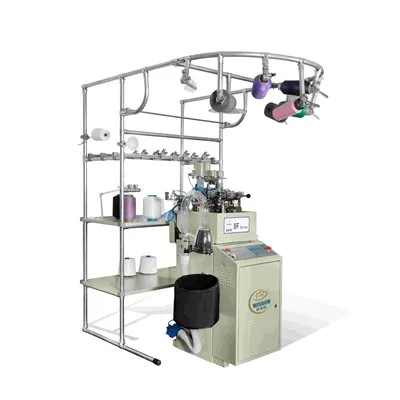
Operating principle:
1. Power part
The power part mainly includes electric motor, electrical control box and operating element.
2. Transmission mechanism
(1) Transmission system The transmission mechanism of the sock machine transmits the motion to the needle cylinder and the control mechanism according to the knitting procedure of the socks. The transmission mechanism of the single-cylinder circular hosiery machine is as follows.
The main shaft is divided into two sections: main shaft I and main shaft II. The main shaft 1 is equipped with a rocking handle 1, an active belt pulley 2, a slow speed belt pulley 4 and a gear 8 from a high speed belt pulley. The slow speed belt pulley is consolidated with the main shaft 1 through the square pin of the crank handle, and the gear 8 is also fixed and integrated with the main shaft 1, while the flexible belt pulley and the fast speed belt pulley (connected with the outer gear 5) are looped on the main shaft 1. superior. When the transmission belt is on the belt pulleys 2, 3, and 4 successively, the needle cylinder is in the state of stop, slow rotation and rapid rotation, respectively.
The clutch 9 is connected with the main shaft II through a crescent key, and can move left and right along the main shaft II. When the clutch moves to the right and engages with the left side of the gear 8, the shaft l and the shaft II are connected into one, and the needle cylinder rotates in one direction. The gear 8 meshes with the crank gear 7, and the crank gear 7 drives the sector gear 11 through the connecting rod 10 to make a rocking motion. When the clutch moves to the left and engages with the right side of the gear 12, the shaft I and the shaft II are separated from each other, and the sector gear 11 drives the needle cylinder to reciprocate.
The sector gear is equipped with two large and small support plates 15 and 16, respectively supporting the push plate 2 and the sprocket 4, thereby transmitting the control mechanism of the hosiery machine.
There is a gear 17 at the lower part of the needle gear 14, which is used to drive the elastic conveying device. A cam 19 is fixedly installed on the inner side of the circular chain gear 13 on the main shaft II, which drives the thread adjusting drum through the tie rod, and is used to exchange the yarn guide when wiping the knitting bar.
(2) Calculation of transmission speed ratio
When knitting different sections of socks, the rotation speed and direction of rotation of the needle cylinder need to be changed. The movement of the needle cylinder has four forms: one-way fast, one-way slow, reciprocating fast and reciprocating slow.
A brief introduction to the socks machine:
Socks machine, the first knitting machine invented by the Englishman Lee in 1589, a knitting machine that uses crochet to knit out forming socks and produce socks. Knitting machines for the production of socks. In 1589, the Englishman W. Lee invented the first knitting machine, which used crochet to knit out forming socks. In 1849, the single-cylinder circular hosiery machine appeared because the latch needle began to be used in small-caliber circular knitting machines.
Originally producing tailor-made socks, it was not until 1857 that socks with pocket heels and toes were knitted. In 1864, the British W. Cotton invented the Cotton Socks Machine (crochet flat knitting machine). In 1900, as the double-headed latch needle began to be applied to the small-caliber circular knitting machine, the double-cylinder circular sock machine appeared to knit ribbed socks. The sock opening can be knitted by a special mechanism of the sock machine, or manually transferred to the sock machine after being completed by other machines. Socks, high heels, heels, toes (including soles and tops), reinforcement loops and toes are knitted by a sock machine.